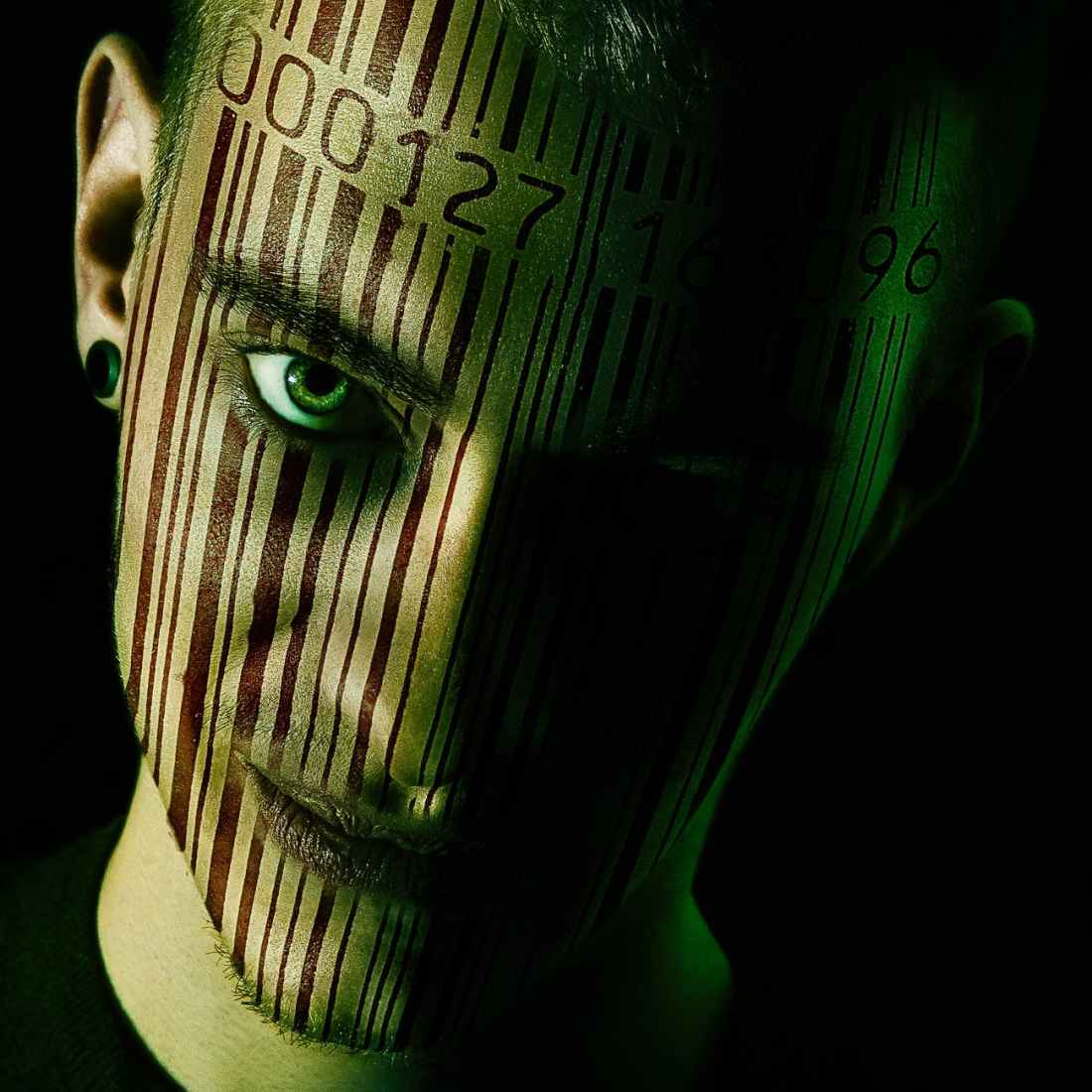
This morning something got into my eye.
One might have been tempted to say it was nothing. Never had a nothing felt like such a something. It was as if a giant needle was poking my eye, bringing pain and discomfort, watery eyes and eye make-up that didn’t quite live up to its former promises of being waterproof.
And so I found myself in the nearest hospital, Atlantic General in Berlin, Maryland, where I described my symptoms. These were diligently keyed in to whatever sophisticated software solution was running on one of the many hospital computers. Afterwards, a polite gentleman barcoded me and took me to the waiting room. Barcoded me? – I can almost hear you say. Yes – he produced a plastic bracelet, on which, below my first name, my last name and my date of birth, I could see my very own, freshly printed, just-about-to-dry-out bar code.
I was sitting in the waiting room, thinking. I had a barcode. Like a jar of gherkins, like a can of Coke, like a box – correction – a soft pack – of Virginia Slim Menthol Lights 120s.[1]
And so I was sitting in the waiting room and the sitting position unleashed the extreme tiredness accumulated in my body over these weeks and months of strenuous physical labour. The body demanded sleep, and, as that wasn’t readily available (falling asleep while waiting for the doctor would have hardly been the height of good manners) my imagination began to race, flashing visions of the social and practical aspects of barcode use in the not-too-distant future.
And so, for security, safety and quality control purposes, every human being – without exception – will be assigned a unique barcode at birth. Farewell, NINs, PINs, PPSNs, NHS[2] and social security numbers: the time of the barcode has come.
Its superiority over the above mentioned will be unquestionable. It will consist of two elements, a static and a dynamic one; with the static being, to a certain extent, dynamic. The thickness and length of the lines and the order of the numbers responsible for key personality traits and intelligence will become permanent when one reaches maturity. The remaining lines and numbers will change with the acquisition of knowledge, skills and experience.
The dynamic nature of the barcode will make it an incredibly useful tool for teachers. It will spell the end of all sorts of arduous tests and examinations. Teachers will believe it when they see it: the pupil’s knowledge, and any gaps therein, will appear on the monitor of a custom-made (and approved by the Department for Education) computer as soon as their bar code is scanned. There will be no way to cheat or to get away with not knowing Mendeleev’s periodic table. It will take no more than ten minutes to check the homework of a class of 30, and – most importantly – conscious and unconscious bias will be once and for all eliminated from the assessment process.
The barcode will revolutionise the job market. There will be no more job advertisements like this: We are looking to employ a bank clerk with five years of banking experience in Japan, fluent in written and spoken Japanese.[3] The new adverts will sound more or less like this: ‘We are looking to employ a bank clerk with an easy to scan bar code, as similar as possible to…. [some sample lines and numbers].’ The recruitment process will be led by the highly qualified members of the Institute for Barcodes. Naturally, their profession will become one of the most prestigious and well paid ones, similarly to these of doctors and lawyers.
Since we’re on the subject of money, it would be appropriate to mention that the barcode will have a special payment feature. We will be able to use it just like any bank card. Ever heard of an easier way to pay for your weekly shopping? No more worrying about losing bank cards or having them stolen. No more risk of a heart attack at the checkout when the cashier politely informs us: We don’t accept American Express.
And even if a situation requiring urgent medical assistance arose, the barcode, which will contain information about the general health of the individual, including their blood group and chronic illnesses, will make their treatment a lot more efficient and straightforward.
The barcode will boast an in-built truth-telling indicator, also known as a lie detector. Scanned during a court or police interrogation, it will indicate the moment when a lie is uttered with a split-second precision. This will lead to the end of all criminal activity; to the end of all hypocrisy. Open and honest relationships will flourish. The world will become a better place. All thanks to the barcode. Codes… Bars… Bars… Codes…Codes….
The voice of the doctor startles me. What happened. I explain. The doctor examines my eye, asks a few questions, prescribes medicines, wishes me a nice day and leaves.
I leave, too. I go to the pharmacy and then take the bus home. (White and blue. Squeaky clean. Absolutely bloody freezing – arctic air blasting from the air conditioning as the mercury outside hits 100° F. Ride all day for two dollars, exact fare required.) The people on the bus seem to be staring at me and I don’t really understand why.
I get home, lie on the sofa and fall asleep. After a while, I wake up. My brain is receiving signals of discomfort and identifies them as coming from the wrist of my right arm and caused by the presence of a tight object.
I look down.
It’s the barcode. I had forgotten to remove the bracelet. I can now understand the quizzical looks of the strangers on the bus. I attempt to undo the plastic clasp. Nothing. I try to widen the bracelet, to slide it down my hand. Nothing. It is too tight, too strong. I grab a pair of scissors and begin to cut.
I succeed, eventually. I take the bracelet off and head to the rubbish bin.
I stop mid-way. I go back and put my barcode in a drawer.
One day it may come in handy.
[1] As a non-smoker, I consider it quite an achievement to have memorised a brand name of such length.
[2] NIN (National Insurance Number) – a UK social security number; PPSN (Personal Public Service Number) – an Irish national insurance number; NHS – British national health service number.
[3] A genuine advertisement from the Polish weekly Gazeta Wyborcza.


